Why Your Ship’s Turbocharger Surges — and What Is Actually Causing It
You are crossing the North Sea. The engine is running at slow speed. Then you hear it — a loud, rhythmic banging from the turbocharger. The whole unit shakes. The scavenge air pressure drops. The chief engineer calls the bridge to reduce speed.
That is turbocharger surge. Every marine engineer has heard it at least once. Most know it is bad. Fewer know exactly why it happens — and that matters, because the cause tells you what to fix.
—
What Is Actually Happening Inside the Turbocharger
The turbocharger has one job. It takes exhaust gas from the engine, uses that energy to spin a turbine, and that turbine drives a compressor. The compressor pushes fresh air into the engine. More air means better combustion and more power.
The compressor works inside a specific range. It needs enough airflow to maintain stable pressure. Think of it like a fan. If you block the airflow too much, the fan cannot push air forward anymore. The air reverses direction. Then it pushes forward again. Then reverses again. This cycle happens very fast — several times per second. That is the banging sound you hear. That is surge.
The rotor is spinning at very high speed when this happens. Each reversal hits the bearings with a load they are not designed for. A few seconds of surge causes no permanent damage. Several minutes can destroy the bearings completely.
—
The Four Most Common Causes on Ship Engines
1. Slow steaming
This is the most common cause today. When the engine runs at low load, it produces less exhaust gas. Less exhaust gas means less energy to the turbine. The turbocharger slows down. The compressor delivers less air. At some point, the airflow drops below the minimum needed to stay stable — and surge begins.
Vessels that slow steam regularly deal with this far more than vessels running at normal load. The turbocharger was designed and matched for higher engine loads. At low load, it is operating outside its comfortable range.
2. Dirty nozzle ring
The nozzle ring sits at the turbine inlet. It directs exhaust gas onto the turbine blades at the correct angle and speed. When the nozzle ring is fouled — carbon deposits from combustion, especially on HFO — the gas flow becomes uneven. The turbine does not spin as freely. The compressor loses speed. Surge follows.
A fouled nozzle ring does not cause sudden surge. It causes gradual surge — the problem gets worse over weeks until the crew notices it happening more often, at slightly higher engine loads than before.
3. Dirty air filter or air cooler
If the compressor cannot get clean air in, it cannot push enough air out. A blocked air filter or a fouled charge air cooler increases resistance on the inlet side. The compressor works harder for less result. The pressure ratio becomes unstable. You get surge.
This cause is easy to miss because the air filter and charge air cooler are not always checked on the same schedule as the turbocharger itself.
4. Cylinder imbalance
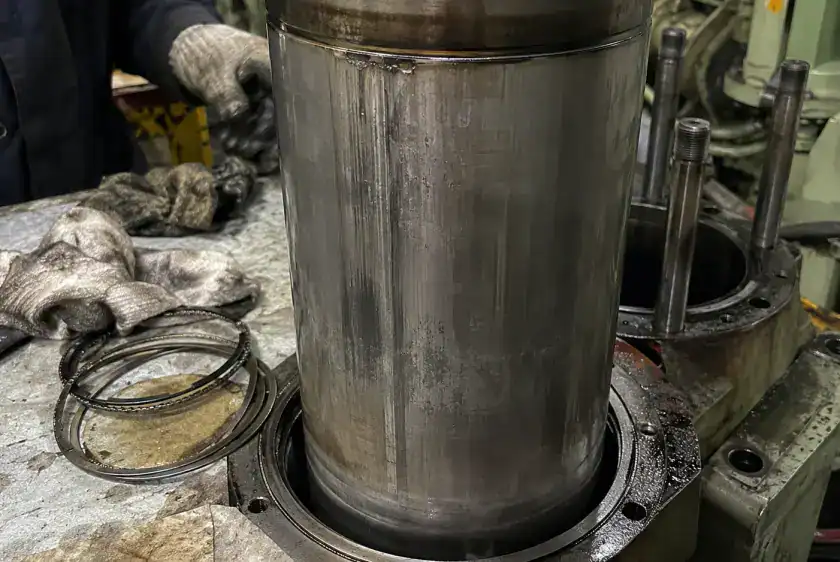
If one or two cylinders are producing significantly more or less power than the others — because of a worn injector, a leaking exhaust valve, or a tired piston ring — the exhaust gas leaving the engine is uneven. The turbocharger receives pulses of energy instead of a steady flow. Those pulses push it in and out of the stable operating range. Surge becomes intermittent and harder to diagnose.
This is the cause most often confused with a turbocharger problem when the real issue is in the engine itself.
—
What to Check First
Before calling a turbocharger specialist, check three things onboard.
Look at the exhaust gas temperatures across all cylinders. If one or two cylinders are significantly away from the average, you have a cylinder balance problem. Fix that first.
Check the scavenge air pressure against the engine’s reference curve for your current RPM. If the pressure is low for the load, the turbocharger is underperforming — either from a dirty nozzle ring or from a dirty charge air cooler.
Check the turbocharger RPM if your engine displays it. A turbocharger running noticeably below its expected speed at a given engine load is a sign of nozzle ring fouling or bearing wear.
—
The Practical Reality
Surge is rarely a turbocharger failure. Most of the time, it is the engine or the operating conditions telling you something is wrong elsewhere. The turbocharger is just the first place you hear it.
A clean nozzle ring, balanced cylinders, and an engine running at appropriate load will eliminate surge in most cases without touching the turbocharger at all.
The noise is the symptom. Finding the cause takes ten minutes of reading your engine data correctly.