Types of Ballast Water Treatment Systems: UV, Electrochlorination and TRO Explained
Quick answer: Almost every type of ballast water treatment system filters the water first, then disinfects it. Three types dominate today’s fleet: filtration + UV, electrochlorination (electrolysis) and chemical injection. The biggest difference is whether the system adds an active substance to the water. If it does, the crew has to measure the total residual oxidant (TRO) and neutralise it before discharge. A filtration + UV system adds nothing, so it has no TRO to manage.
Since 8 September 2024, every ship under the IMO Ballast Water Management Convention has had to meet the D-2 discharge standard. So the question is no longer whether to fit a system. It’s what the system you choose will ask of your crew every time they ballast.
On paper, every type-approved system meets D-2. At sea, each ballast water treatment method has its own weak spot: murky water for UV, fresh or cold water for electrochlorination, chemical stock for injection systems. This guide compares the main BWTS types by technology, not by brand, and explains TRO, holding time and what to ask before a retrofit. For the basics, start with what a ballast water treatment system is and how it works on a ship.
How ballast water treatment systems are grouped
Big question, simple start. A filter removes larger organisms and sediment, then a disinfection stage deals with everything small enough to get through. Each type is named after that second stage.
For approval, the IMO splits systems into two groups. Every system needs type approval under the BWMS Code. Systems that use an active substance, which is a fancy way of saying a chemical that kills organisms, also need IMO approval under a separate procedure known as G9. G9 has two tiers, Basic and Final Approval, and checks that the substance poses no unreasonable risk to the environment or human health (IMO).
That split decides whether your crew will handle chemicals, monitor residuals and neutralise the discharge, or not.
| Type | How it disinfects | Active substance | IMO G9 approval |
|---|---|---|---|
| Filtration + UV | UV-C light damages the DNA of organisms so they can’t reproduce | None | Not needed |
| Electrochlorination (electrolysis) | An electric current turns seawater into oxidants, mainly hypochlorite | Generated on board | Needed |
| Chemical injection | A biocide, or chemicals that make one, is carried on board and dosed into the ballast line | Stored on board | Needed |
| Ozone, deoxygenation and others | Ozone gas, inert gas or other physical methods | Depends on the system | Depends on the system |
According to DNV, systems using UV, electrolysis or chemical injection hold the largest market share today. So those are the three we’ll look at closely.
Filtration + UV systems
How it works
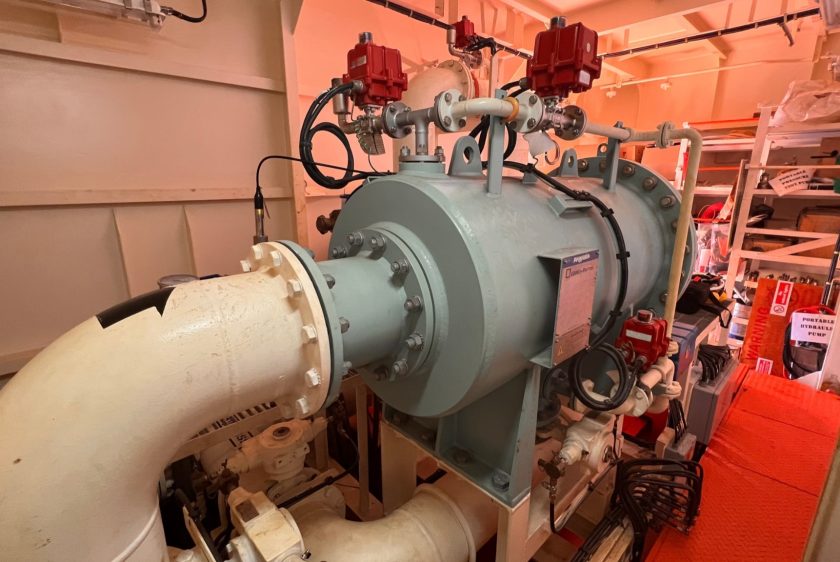
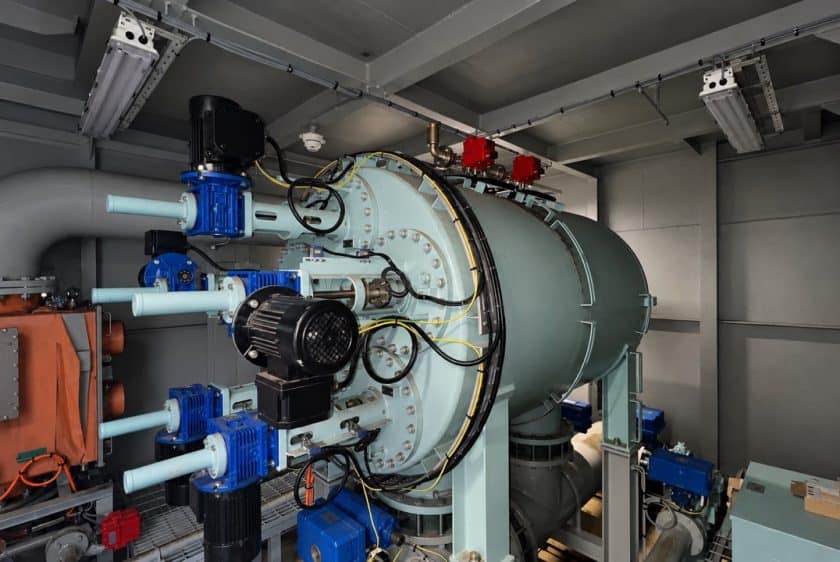
The ballast pump pushes seawater through an automatic screen filter, which backflushes itself when the pressure difference across the screen rises. The filtered water then passes through UV reactors, where UV-C light damages the DNA of the organisms left in it. They may still be in the tank, but they can’t reproduce.
On deballasting, the water bypasses the filter and goes through the UV reactor a second time, which deals with anything that regrew in the tank. That’s why most UV systems need no holding time under IMO approval.
What UV depends on
UV doesn’t care about salinity or temperature. DNV notes that filter and UV systems are unaffected by both and produce no harmful by-products.
What it does care about is water clarity, measured as UV transmittance (UVT). Silty, low-UVT water absorbs more of the light, so the system needs more power to deliver the same dose, and reduces the flow when it runs out of headroom. That’s the main trade-off with UV, and the one to check against your trading pattern.
What it asks of your crew
- Replace UV lamps on the maker’s schedule, not when an alarm forces it.
- Keep the quartz sleeves clean. Automatic wipers do most of this, but the wiper parts wear.
- Inspect and replace filter elements.
- Keep the UV intensity, flow and pressure sensors calibrated.
What’s missing from that list is just as important: no chemicals to order, store or log, no neutralising agent and no TRO sensor. Nobody has ever been asked for the TRO calibration record of a system that doesn’t make TRO.
Electrochlorination (electrolysis) systems
How it works
An electrolysis ballast water treatment system, usually called electrochlorination or EC, makes its own disinfectant. An electric current passes through seawater in an electrolytic cell and produces oxidants, mainly sodium hypochlorite. Many designs treat a side stream of the ballast flow and inject it back into the main line. The system controls the dose by measuring the total residual oxidant (TRO) in the treated water.
On deballasting, the oxidant left in the water is neutralised with a reducing agent, such as sodium bisulphite or sodium thiosulphate. TRO is measured again before the water goes overboard.
What EC depends on
Salt and warmth. Electrolysis needs chloride in the water, so fresh and low-salinity water cuts the oxidant output. Some systems carry seawater or brine for fresh-water ports; others reduce the flow. Cold water slows the process, and some certificates set a minimum water temperature. Read the limits on the type-approval certificate before you plan a fresh-water call.
Imagine a ship that ballasts in cold, brackish water in one port and warm, silty river water in the next. An EC system has the harder time in the first port, a UV system in the second. Your trading pattern decides which trade-off costs you more.
Hydrogen and crew safety
Electrolysis also produces hydrogen. DNV says it “shall be correctly handled for safety of the ship”, and systems are designed to separate and vent it. In 2016, the UK Health and Safety Executive issued a safety bulletin after an electrolytic chlorination unit failed catastrophically on a semi-submersible installation. It warned that electrodes can stay energised when flow is low or absent, for example during maintenance. Good designs guard against this, but it’s one more hazard to assess and one more interlock to test.
Chemical injection systems
Instead of making a disinfectant from seawater, these systems carry chemicals on board, either a ready-made biocide or the precursors to make one, and dose them into the ballast line. Peracetic acid and chlorine dioxide are two common examples. Power draw is low, because there are no lamps or electrolytic cells to supply.
The trade-off is logistics. The chemical has to be bought, stored, handled under its safety data sheet and resupplied in the right ports. DNV notes that chemical injection systems have a higher operational cost than other ballast water technologies. Most also need a holding time, and many need a neutralisation step before discharge.
Other ballast water treatment methods
- Ozone: injected as a gas. Ozone is toxic, so DNV says additional safety measures and crew training are needed.
- Deoxygenation: inert gas lowers the oxygen in the ballast tanks until organisms can’t survive. It needs time and well-sealed tanks.
- Heat, cavitation, magnetic fields and plasma: older guides list them alongside the main types, but you’ll meet them in textbooks more often than in engine rooms. If anyone offers you one, ask for the type-approval certificate first.
What is TRO in a BWTS?
TRO stands for total residual oxidant. It’s the amount of oxidising disinfectant left in the ballast water after treatment, usually expressed as milligrams of chlorine per litre (mg/L as Cl2).
TRO in a ballast water treatment system matters twice. On ballasting, it’s the control signal: the system raises or lowers the dose to hold its target TRO. On deballasting, it’s the compliance figure: the residual has to be neutralised below the discharge limit before the water goes overboard. Under IMO rules, the limit is set for each system through its G9 approval. In US waters, the 2013 Vessel General Permit sets a maximum for each type of residual.
| Residual in discharged ballast water | Instantaneous maximum under the 2013 VGP |
|---|---|
| Total residual oxidants (chlorine and ozone systems) | 100 µg/L (0.1 mg/L) |
| Chlorine dioxide | 200 µg/L |
| Peracetic acid | 500 µg/L |
| Hydrogen peroxide | 1,000 µg/L |
These limits come from the EPA’s summary of the 2013 VGP. They apply only to systems that use an active substance. The 2013 VGP and existing USCG rules stay in force until the USCG’s regulations under the Vessel Incidental Discharge Act (VIDA) take effect, according to the EPA.
Why TRO sensors cause trouble
The whole TRO loop depends on one sensor. Most use colorimetric (DPD reagent) or amperometric measurement, which means reagents to replace, sample lines to keep clean and calibration to keep in date. A sensor that reads low on ballasting makes the system overdose, leaving more oxidant in your tanks than you need. On deballasting, a sensor that reads low can hide a discharge above the limit. And inspectors do look at this: see BWTS inspections in 2026 and the IMO’s increased BWTS inspection focus.
Does a UV system need TRO monitoring? No. It adds no oxidant, so there’s no residual to measure or neutralise.
Holding time: the constraint that shows up in port
Holding time is the minimum time treated water must stay in the tank before it can be discharged. The type-approval certificate sets it, and it can decide whether a short-sea ship deballasts on schedule.
- EC and chemical systems: often need a holding time, because the oxidant needs contact time. The certificate may set different times for fresh, brackish and marine water.
- UV systems under IMO approval: usually none, because the water is treated again on discharge.
- UV systems under USCG approval: usually a minimum holding time. The USCG tests with a live/dead stain method, and UV leaves many cells intact, so organisms that can no longer reproduce can still count as “alive”. In December 2015, the USCG ruled that the MPN culture method, which measures whether organisms can reproduce, was not an equivalent test. In 2024, it began an environmental review of accepting a viability method. We found no final decision when we checked in October 2026.
Here’s what that means in practice: if your ship makes short voyages to US ports, check the holding time on the USCG certificate before you choose a system, not after.
Which type of ballast water treatment system fits your ship?
It depends on four things: your ballast pump capacity, your spare electrical power, the water you ballast in and where you trade. So who decides? Usually the superintendent signs off, the yard prices the installation, and the chief engineer lives with the result for the rest of the ship’s life. It’s worth getting all three in the room.
| Filtration + UV | Electrochlorination | Chemical injection | |
|---|---|---|---|
| Active substance on board | None | Generated on board | Stored on board |
| TRO monitoring and neutralisation | Not needed | Needed | Usually needed |
| Salinity and temperature | Unaffected | Output drops in fresh, brackish or cold water | Depends on the chemical |
| Water clarity (UVT) | Low UVT raises power demand or cuts flow | Organic-rich water uses up oxidant | Organic-rich water uses up biocide |
| Holding time | Usually none under IMO; usually set under USCG | Often set | Often set |
| Gas hazards | None | Hydrogen to separate and vent | Depends on the chemical |
| Power draw | The main running cost; rises with flow and low UVT | Rises in cold or low-salinity water | Low |
| Main consumables | UV lamps, quartz sleeves, wiper parts, filter elements | Electrodes, neutralising agent, TRO sensor reagents | Biocide, neutralising agent, sensor reagents |
| Chemicals the crew handles | None | Neutralising agent, sometimes brine | Biocide and neutralising agent |
What to watch out for before a retrofit
- Does the system’s rated capacity match your ballast pump flow, or will it slow ballasting down?
- Do your regular ports fall inside the salinity, temperature and UVT limits on the certificate?
- What holding time applies under each certificate, IMO and USCG?
- On a tanker, can the filter and reactor go into the pump room, and with which hazardous-area certification?
- What’s on the yearly consumables list, and who can supply genuine spares where you trade?
- Who will commission the system, train the crew and calibrate the sensors after delivery?
Where PANASIA GloEn-Patrol fits
PANASIA’s GloEn-Patrol™ (often searched as Gloen Patrol) is a filtration + UV system, so everything above about UV applies to it. Here’s how it handles the trade-offs:
- No active substances. It’s a fully physical process: no G9 chemistry, no TRO sensor, no neutralising agent and no hydrogen.
- Filtration. A 50 µm screen filter with differential-pressure backflushing and elements in SUS 316L or Hastelloy.
- UV reactors. Automatic cleaning wipers keep the quartz sleeves clear, and an explosion-proof UV option is available for hazardous areas.
- Capacity. Filter units from 50 to 3,000 m³/h, and a USCG approval that covers systems from 50 to 6,000 m³/h.
- Control. A Siemens PLC with touch-screen HMI, 24 months of data logging and an alarm interface to the ship’s AMS. That log is the first thing to pull when an inspector asks how the system has been run.
- Approvals. IMO type-approved, with USCG type approval since December 2018. The current USCG certificate (162.060/14/3) runs to December 2028, covers GloEn-Patrol and GloEn-Patrol 2.0, and sets no salinity limitation. As with other UV systems, the USCG certificate sets a minimum holding time in US waters, so check which certificate your installation falls under.
Nordast is an official PANASIA distributor and authorised service and spare parts centre, with engineers trained by PANASIA. We support the PANASIA GloEn-Patrol UV ballast water treatment system from selection and retrofit engineering through installation supervision, commissioning, sensor calibration and crew training. We also supply genuine spares: UV lamps, filter elements and sensors. Control faults go to our PLC and automation engineers. For the full PANASIA range, see Nordast x PANASIA Systems.
If you remember one thing
Every type-approved system meets D-2 on the test bench. The type you choose decides what your crew manages at sea: chemicals, TRO and neutralisation with an active-substance system, or water clarity and lamps with UV. Choose the trade-off your trading pattern can live with.
Frequently asked questions
What are the main types of ballast water treatment systems?
The main types of ballast water treatment systems are filtration + UV, electrochlorination (electrolysis) and chemical injection. DNV says these three hold the largest market share today. Almost all of them filter the water first, then disinfect it. Ozone and deoxygenation systems exist but are much less common.
What is TRO in a ballast water treatment system?
TRO (total residual oxidant) is the oxidising disinfectant left in ballast water after electrochlorination, ozone or chlorine-based treatment, measured in mg/L as Cl2. The crew must neutralise it below the discharge limit before deballasting. In US waters, the 2013 Vessel General Permit limit is 0.1 mg/L. UV systems produce no TRO.
Which type of ballast water treatment system is best?
No single type of ballast water treatment system is best for every ship. The right choice depends on ballast pump flow, spare electrical power, the water you ballast in and your trading area. UV avoids chemicals and TRO but depends on water clarity. Electrochlorination copes with murky water but depends on salinity and temperature.
Does a UV ballast water treatment system work in fresh water?
Yes. A UV ballast water treatment system works in fresh, brackish and seawater, because UV is unaffected by salinity and temperature. Its limit is water clarity, measured as UV transmittance (UVT). In silty, low-UVT water, the system needs more power or reduces the ballast flow.
Do UV ballast water treatment systems need a holding time?
Under IMO type approval, UV ballast water treatment systems usually need no holding time, because the water is treated again on discharge. Under USCG type approval, UV systems usually have a minimum holding time, set on the certificate. Check the USCG certificate before trading to US ports.
Can a BWTS be installed in a tanker pump room?
Yes, a BWTS can be installed in a tanker pump room if its components are certified for that hazardous area. The filter and UV reactor go in the pump room with explosion protection, while the control and power panels stay in a safe area. PANASIA offers an explosion-proof version of its GloEn-Patrol UV unit.
Choosing a system for a retrofit, or running one that doesn’t suit your trading pattern? Send the vessel type, ballast pump capacity and main trading area to systems@nordast.com. Our Environmental Systems team will tell you what a GloEn-Patrol installation would involve, and what it wouldn’t.